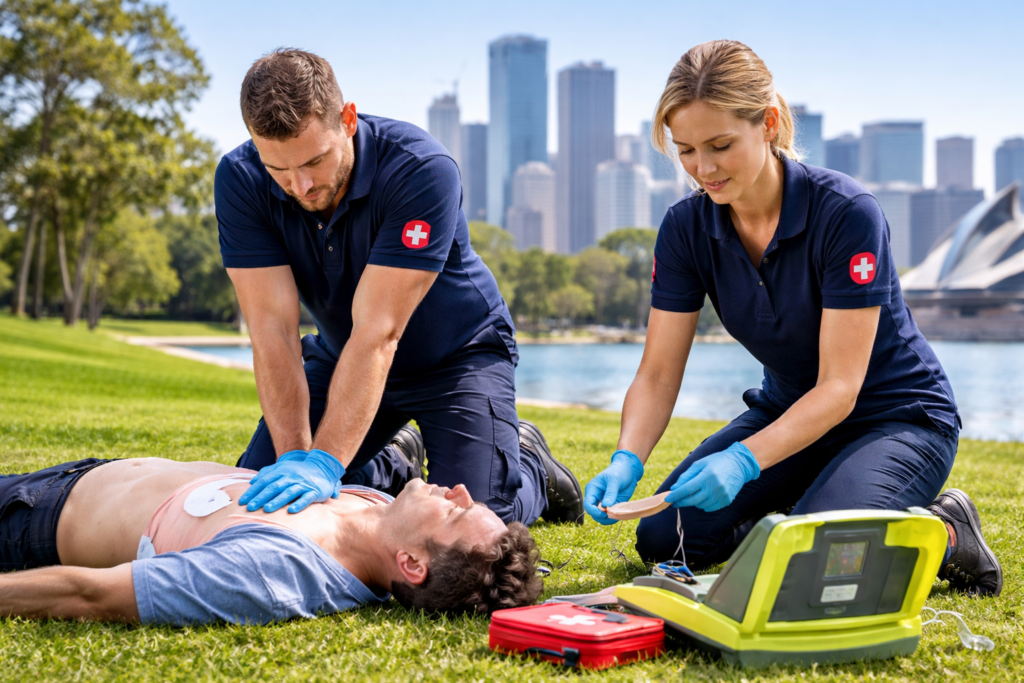
When a sudden cardiac arrest occurs, every second counts. Across Sydney and New South Wales, thousands of people work, commute, study, and socialise every day—often unaware that survival in a cardiac emergency depends on both CPR and AED use. While many people search online for “AED vs CPR Sydney” or “CPR or AED – which is better?”, the truth is far more straightforward: you need both, working together.
At Training NSW, we regularly see how combining CPR and AED training in Sydney empowers everyday people to save lives before emergency services arrive.
Cardiopulmonary Resuscitation (CPR) is a life-saving technique that manually keeps blood and oxygen flowing when the heart stops beating. In busy urban areas like Sydney, CPR is often the first response before an AED or ambulance becomes available.
Most importantly, CPR:
Maintains circulation to the brain and heart
Slows the effects of oxygen deprivation
Dramatically improves outcomes when followed by AED use
For this reason, CPR training in Sydney is a fundamental requirement across workplaces, childcare centres, gyms, and construction sites.
Learn more or enrol in CPR – HLTAID009
An Automated External Defibrillator (AED) is a portable device that analyses heart rhythm and delivers an electrical shock when needed. Unlike CPR, which supports circulation, an AED addresses the electrical malfunction of the heart.
AEDs are:
Designed for public and workplace use
Guided by clear voice prompts
Safe and effective even for first-time users
In fact, early AED access combined with CPR can more than double survival rates. That is why AED availability in Sydney workplaces is increasingly encouraged and, in some industries, expected.
AED use is included in nationally recognised first aid courses such as:
Although CPR and AEDs are often discussed together, they perform different but complementary roles.
| CPR | AED |
|---|---|
| Manual chest compressions | Automated heart rhythm analysis |
| Keeps oxygenated blood flowing | Restores normal heart rhythm |
| Requires physical effort | Voice-guided and user-friendly |
| Must begin immediately | Most effective within 3–5 minutes |
Therefore, when comparing AED vs CPR in Sydney, it’s clear that one does not replace the other. Instead, CPR buys time, while the AED fixes the problem.
To put it simply, CPR without an AED often cannot restart the heart, while an AED without CPR may arrive too late to be effective. Together, however, they form the gold standard of cardiac emergency response.
Across NSW:
Ambulance response times can vary
Many cardiac arrests occur in workplaces and homes
Immediate bystander action saves lives
As a result, SafeWork-aligned organisations increasingly prioritise CPR and AED training in Sydney to meet duty-of-care obligations and improve safety outcomes.
At Training NSW, our courses are designed to suit different industries while embedding both CPR and AED competency.
Supervisors & High-Risk Workplaces
Each course includes practical, hands-on training delivered by qualified trainers in Sydney.
Because cardiac emergencies can happen anywhere, CPR and AED training in NSW is strongly recommended for:
Workplace first aid officers
Childcare educators (ACECQA-aligned)
Construction and electrical workers
Fitness centres and sports clubs
Parents, carers, and community members
All Training NSW courses are delivered in partnership with ABC First Aid and meet national standards.
Training NSW courses align with:
ASQA standards
training.gov.au units of competency
ACECQA childcare requirements
Consequently, your certification remains nationally recognised, compliant, and audit-ready.
While CPR keeps blood flowing, it usually cannot restart the heart. An AED is often essential for survival.
Yes. AEDs are designed for public use. However, formal CPR and AED training in Sydney improves speed and confidence.
Requirements vary by industry, but many NSW workplaces are strongly encouraged or required to have AEDs and trained staff.
CPR is renewed annually, while First Aid certification is valid for three years, with CPR refreshed yearly.
Courses such as HLTAID011 and HLTAID014 include comprehensive CPR and AED instruction.
When it comes to AED vs CPR in Sydney, the debate ends quickly. CPR buys crucial time, AEDs restore life-saving rhythm, and together they save lives.
If you live or work in Sydney or greater NSW, investing in CPR and AED training with Training NSW ensures you’re prepared when it matters most.
Book your CPR, AED, or First Aid course today
Chester Hill, NSW | Serving Sydney-wide
1300 000 765 | https://trainingnsw.org
Posted on Google
 Đăng Khôi Nguyễn
Trustindex verifies that the original source of the review is Google.
All goodPosted on Google Brenda De FilippisWe completed group training on-site and had an excellent experience from start to finish. Muhammad was professional, accommodating, and made the entire process feel effortless. Communication was strong and prompt throughout. I would not hesitate to recommend their services to anyone.Posted on Google
 Renee KimaniThe lessons were really educative. Mohammad Sadiqui was really helpful through the training. Loved it.Posted on Google
 Mariam AMohamad siddique is a great instructor. I always do my first aid and CPR herePosted on Google
 Jacob JidaMohammad siddiqua was very understandable and caring, he spoke to us one by one and loved working with us and giving his knowledge of experience, would highly recommend coming and doing your cpr and first aid course herebPosted on Google
 Naomi GituatiMy experience was amazing and educatingPosted on Google
 Ryan KipchumbaFantastic educational and very supportivePosted on Google
 Massey ShiraziNSW TRAINING trainer was one of the most energetic and positive person in CPR trainingLoad more