Tag: cpr certificate sydney

  • WHS Requirements NSW | First Aid & CPR Compliance Sydney

    WHS Requirements for Small Businesses NSW: First Aid & CPR Compliance Guide Sydney

    Running a small business in Sydney comes with many responsibilities. However, one of the most important — and often overlooked — is understanding your WHS requirements in NSW.

    Whether you operate a childcare centre, construction site, office, or retail store, you must ensure your workplace is safe, compliant, and prepared for emergencies.

    In this guide, we’ll break down workplace safety compliance in Sydney, explain first aid requirements for businesses, and show exactly what training your staff need.

    #1 First Aid & CPR Provider’s in Sydney ⭐

    Posted on Google Google
    Đăng Khôi Nguyễn profile picture
    Đăng Khôi Nguyễn
    Google star 1Google star 2Google star 3Google star 4Google star 5Trustindex verifies that the original source of the review is Google.
    All good
    Posted on Google Google
    Brenda De Filippis profile picture
    Brenda De Filippis
    Google star 1Google star 2Google star 3Google star 4Google star 5Trustindex verifies that the original source of the review is Google.
    We completed group training on-site and had an excellent experience from start to finish. Muhammad was professional, accommodating, and made the entire process feel effortless. Communication was strong and prompt throughout. I would not hesitate to recommend their services to anyone.
    Posted on Google Google
    Renee Kimani profile picture
    Renee Kimani
    Google star 1Google star 2Google star 3Google star 4Google star 5Trustindex verifies that the original source of the review is Google.
    The lessons were really educative. Mohammad Sadiqui was really helpful through the training. Loved it.
    Posted on Google Google
    Mariam A profile picture
    Mariam A
    Google star 1Google star 2Google star 3Google star 4Google star 5Trustindex verifies that the original source of the review is Google.
    Mohamad siddique is a great instructor. I always do my first aid and CPR here
    Posted on Google Google
    Jacob Jida profile picture
    Jacob Jida
    Google star 1Google star 2Google star 3Google star 4Google star 5Trustindex verifies that the original source of the review is Google.
    Mohammad siddiqua was very understandable and caring, he spoke to us one by one and loved working with us and giving his knowledge of experience, would highly recommend coming and doing your cpr and first aid course hereb
    Posted on Google Google
    Naomi Gituati profile picture
    Naomi Gituati
    Google star 1Google star 2Google star 3Google star 4Google star 5Trustindex verifies that the original source of the review is Google.
    My experience was amazing and educating
    Posted on Google Google
    Ryan Kipchumba profile picture
    Ryan Kipchumba
    Google star 1Google star 2Google star 3Google star 4Google star 5Trustindex verifies that the original source of the review is Google.
    Fantastic educational and very supportive
    Posted on Google Google
    Massey Shirazi profile picture
    Massey Shirazi
    Google star 1Google star 2Google star 3Google star 4Google star 5Trustindex verifies that the original source of the review is Google.
    NSW TRAINING trainer was one of the most energetic and positive person in CPR training

    What Are WHS Requirements in NSW?

    To begin with, WHS (Work Health and Safety) laws require all businesses in NSW to:

    • Provide a safe working environment
    • Minimise risks to employees and visitors
    • Ensure staff are properly trained
    • Be prepared for emergencies, including medical incidents

    In other words, WHS is not optional — it is a legal requirement.

    As a result, failing to comply with workplace safety laws can lead to:

    • Fines and penalties
    • Legal liability
    • Increased workplace incidents

    First Aid Requirements for Small Businesses in NSW

    Most importantly, one of the core WHS requirements for small businesses is first aid readiness.

    Every workplace must have:

    • A fully stocked first aid kit
    • At least one trained first aider available at all times
    • Clear emergency response procedures

    For most businesses, the required course is: Provide First Aid (HLTAID011)

    This course covers:

    • CPR techniques
    • Managing injuries and illnesses
    • Workplace emergency response

    Therefore, it is considered the standard workplace first aid requirement in Australia.

    CPR Training Requirements for Workplaces

    In addition to first aid certification, CPR training is also essential.

    In fact, CPR must be refreshed every 12 months to remain compliant.

    Recommended course: Provide CPR (HLTAID009)

    This is particularly important for:

    • Gyms and fitness centres
    • Construction and trade workers
    • Customer-facing businesses
    • High-risk environments

    Consequently, keeping CPR training up to date ensures your team can respond effectively during critical situations.

    Industry-Specific WHS Compliance (Childcare & More)

    While general workplace safety applies to all businesses, some industries have additional WHS compliance requirements.

    Childcare & Education Sector

    For example, if you work with children, you must complete:

    • First Aid (HLTAID012)
    • Child Protection training

    Accredited Child Protection Course ↩️

    This ensures compliance with:

    • NSW mandatory reporting laws
    • Child safety frameworks
    • Regulations guided by ACECQA

    🔗 Learn more: https://www.acecqa.gov.au/

    Workplace Risk Management & Emergency Planning

    Beyond training, businesses must also implement proper risk management strategies.

    Specifically, you are required to:

    • Identify workplace hazards
    • Assess risks
    • Apply control measures
    • Train staff in emergency procedures

    For instance, this includes:

    • Fire safety protocols
    • Medical emergency response
    • Evacuation plans

    Therefore, combining training with planning ensures full WHS compliance.

    Training Certification & Compliance Records

    Equally important, all businesses must maintain proper documentation.

    This includes:

    • Staff training records
    • Valid certificates
    • Incident reports

    Moreover, certificates must be issued by a recognised training provider.

    👉 Training NSW delivers courses in partnership with ABCFirst-Aid (RTO#3399)

    You can also verify qualifications via ↩️

    Additionally, industry safety standards can be explored through ↩️

    WHS Compliance Checklist for Small Businesses (Sydney)

    To simplify things, here’s a quick compliance checklist:

    ✔ First aid kit available
    ✔ CPR-trained staff (updated yearly)
    ✔ First aid certification (HLTAID011)
    ✔ Emergency procedures in place
    ✔ Training records maintained
    ✔ Industry-specific compliance completed

    As you can see, meeting WHS requirements is straightforward when approached step by step.

    Common WHS Mistakes Small Businesses Make

    Unfortunately, many businesses still fall short.

    Here are the most common mistakes:

    • ❌ No trained first aider on-site
    • ❌ Expired CPR certificates
    • ❌ No documented emergency plan
    • ❌ Missing compliance records
    • ❌ Ignoring industry-specific training

    Therefore, staying proactive is key to avoiding risks and penalties.

    Why Choose Training NSW for Workplace Compliance

    When it comes to meeting WHS requirements in Sydney, choosing the right training provider makes a difference.

    Training NSW offers:

    • Fast-track courses (30–60 minutes practical sessions)
    • Same-day or next-day certificates
    • Convenient Sydney location (Chester Hill, near Bankstown)
    • On-site group training for businesses
    • Nationally recognised certification

    Explore on-site workplace training

    WHS Requirements NSW: Final Thoughts

    In summary, staying compliant with WHS requirements for small businesses in NSW is essential.

    To remain compliant, you should:

    • Ensure staff complete first aid training
    • Keep CPR certification updated annually
    • Implement workplace safety procedures
    • Maintain accurate training records

    Ultimately, WHS compliance is not just about legal obligations — it’s about protecting your team, your customers, and your business.


    FAQ – WHS Requirements for Small Businesses NSW

    Businesses must provide a safe workplace, ensure first aid readiness, train staff, and implement risk management procedures.

    Yes. Most workplaces must have at least one trained first aider with HLTAID011 certification.

    CPR must be renewed every 12 months to remain compliant.

    Provide First Aid (HLTAID011) is the most common requirement across industries.

    Yes. They must complete childcare first aid and accredited child protection training.

    Yes. Training NSW offers on-site group training tailored to workplace needs.

    Businesses may face fines, legal consequences, and increased liability during workplace incidents.

    Book Your WHS-Compliant Training Today
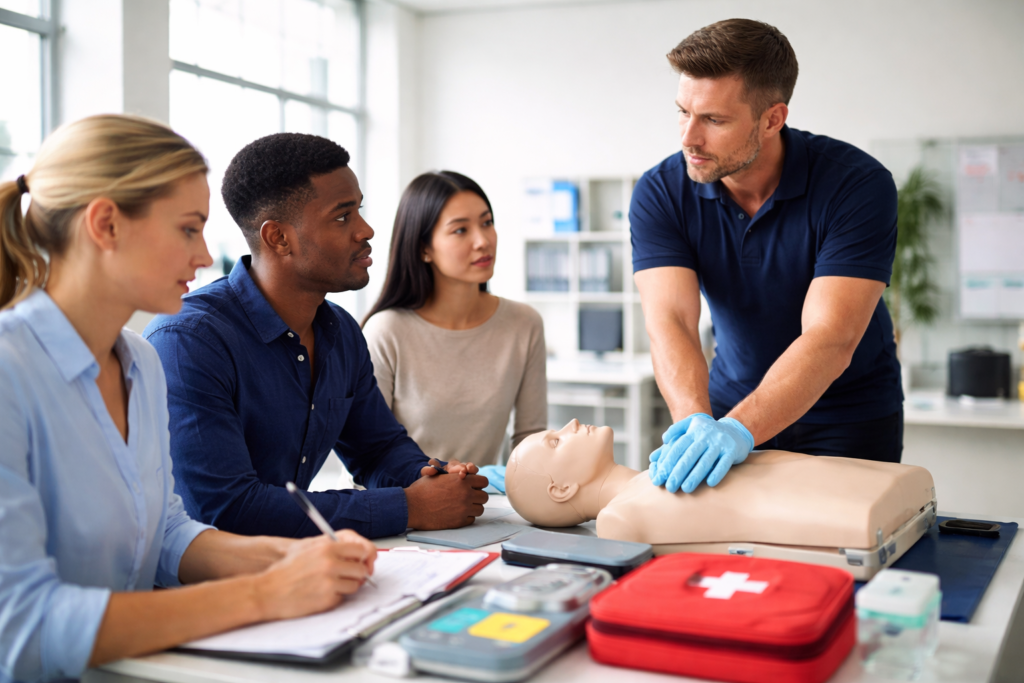
    Workplace first aid training session in Sydney demonstrating CPR for WHS compliance requirements in NSW small business
  • CPR Myths Debunked | CPR Training in NSW – Training NSW

    CPR Myths Debunked: What Every Australian Should Know

    Updated by Training NSW – Your CPR Training Experts in Sydney

    Understanding CPR correctly can literally save a life. However, countless CPR misconceptions continue to circulate throughout NSW communities. Consequently, many people hesitate in emergencies because they’re unsure what is true and what is not. That’s why this article, CPR Myths Debunked: Facts You Should Know, breaks down every common misunderstanding using accurate, evidence-based CPR training facts aligned with Australian standards.


    If you live or work in Sydney, having the right CPR Training in NSW is critical—not only to meet workplace requirements but also to build real confidence in emergency response situations.

    Myth 1: “CPR Restarts the Heart”

    ❌ Myth

    Many people believe CPR restarts a stopped heart.

    ✅ Fact You Should Know

    CPR does not restart the heart. Instead, CPR maintains oxygenated blood flow to the brain and vital organs until a defibrillator delivers a shock, which is the only thing capable of restoring a normal heartbeat.

    Therefore, while CPR alone won’t bring someone “back to life,” it significantly increases the chances of survival until professional help arrives.


    👉 Learn proper CPR techniques through accredited CPR Training in NSW (HLTAID009):
    https://trainingnsw.org/cpr-hltaid009/

    Myth 2: “You Can Get Sued for Doing CPR Wrong”

    ❌ Myth

    Fear of legal consequences stops many NSW bystanders from helping.

    ✅ Fact You Should Know

    Australian Good Samaritan laws protect anyone who attempts CPR in good faith. Furthermore, as long as you are genuinely trying to help, you cannot be held legally responsible.


    Training NSW delivers CPR training in partnership with ABC First Aid (RTO 3399), ensuring all learners understand their legal protections.
    👉 https://abcfirstaid.com.au/

    Myth 3: “Only Qualified People Should Perform CPR”

    ❌ Myth

    Some assume CPR must be left to trained medical professionals.

    ✅ Fact You Should Know

    Any attempt at CPR is far better than doing nothing. Moreover, even untrained bystanders performing “hands-only CPR” can dramatically improve survival outcomes.

    Nevertheless, completing proper HLTAID011 Provide First Aid, which includes CPR, ensures you perform every step safely and confidently.


    👉 Book your course here:
    https://trainingnsw.org/provide-first-aid-hltaid011/

     Myth 4: “You Will Hurt Someone If You Do CPR”

    ❌ Myth

    People often fear causing injuries like broken ribs.

    ✅ Fact You Should Know

    It is true that rib fractures can occur; however, this is not a reason to stop. In fact, broken ribs are common and acceptable during CPR, because keeping the brain supplied with oxygen is far more important.

    ASCIA guidelines support continuing CPR even if you hear or feel ribs crack:
    👉 https://www.allergy.org.au/


    As a result, correct CPR compressions remain the priority.

    Myth 5: “Mouth-to-Mouth Is Always Required”

    ❌ Myth

    Many still believe rescue breaths are mandatory for every situation.

    ✅ Fact You Should Know

    For trained responders, yes—30 compressions : 2 breaths is ideal.
    However, hands-only CPR is strongly recommended when:

    • You are untrained

    • Rescue breaths are unsafe

    • Infection risks are present

    • You are uncomfortable giving breaths

    Training.gov.au confirms these guidelines under the HLTAID009 Provide CPR competency:
    👉 https://training.gov.au/Training/Details/HLTAID009


    Furthermore, hands-only CPR is proven to be extremely effective for adult cardiac arrest.

    Myth 6: “Children Need the Same CPR as Adults”

    ❌ Myth

    Many assume CPR technique is identical regardless of age.

    ✅ Fact You Should Know

    Children and infants require modified CPR:

    • Depth: 1/3 of chest

    • Infants: use two fingers

    • Breaths are essential


    Consequently, anyone working with children—especially in childcare, sports, or education—should complete HLTAID012 Childcare First Aid.

    Myth 7: “A White Card Includes CPR Training”

    ❌ Myth

    Some construction workers mistakenly think CPCWHS1001 White Card covers First Aid or CPR.

    ✅ Fact You Should Know

    A White Card does NOT include CPR or First Aid.
    Construction workers still require at minimum:

    ✔ HLTAID009 Provide CPR
    ✔ HLTAID011 Provide First Aid


    Learn more:
    White Card → https://trainingnsw.org/white-card-course-cpcwhs1001/
    CPR Course → https://trainingnsw.org/cpr-hltaid009/

    Why CPR Training in NSW Matters More Than Ever

    Cardiac arrests remain a leading emergency in Australia. Consequently, quick action—especially in the first 3 minutes—dramatically increases survival rates.

    With Training NSW, you receive:

    • Nationally recognised CPR certification

    • Fast 1-day processing

    • Training aligned with ABC First Aid (RTO 3399)

    • Chester Hill training centre location

    • NSW-focused course delivery


    Ultimately, the right CPR training saves lives.

    Frequently Asked Questions (FAQ)

    CPR must be renewed every 12 months, as recommended by training.gov.au.

    Most practical sessions take  45-60 mins, plus online pre-learning.

    Yes. CPR expires in 1 year while First Aid (HLTAID011) expires every 3 years.

    Absolutely. If a person is unresponsive and not breathing normally, CPR is always recommended.

    Training NSW delivers accredited CPR courses in Sydney:
    👉 https://trainingnsw.org/cpr-hltaid009/

    Final Word: CPR Myths Debunked – Now You Know the Facts

    By understanding the facts you should know and dismissing dangerous CPR myths, you can confidently step in during emergencies. Whether you’re a parent, worker, coach, or member of the public, your willingness to learn can truly change lives.


    👉 Book your CPR Training in NSW now:
    https://trainingnsw.org/cpr-hltaid009/

    Paramedic performing CPR on a training manikin with AED nearby, illustrating CPR myths debunked and accurate CPR training in NSW by Training NSW.
  • CPR Training in Sydney: What to Expect and How to Prepare

    CPR Training in Sydney: What to Expect and How to Prepare

    Taking part in CPR training in Sydney shows your commitment to keeping your community safe. Whether for work or personal reasons, learning CPR gives you the skills to help save lives.

    If it’s your first time, you might be asking: What happens in a CPR course? What should I bring? How can I prepare mentally and physically?

    At Training NSW, we aim to help every participant feel ready and confident by the end of their course. This guide explains what to expect during training, how to prepare and why a CPR course in Sydney is one of the most valuable programs you can join.

    What to Expect During CPR Training

    The CPR course in Sydney follows a clear and simple structure so you feel prepared from the start.

    We deliver the HLTAID009 Cardiopulmonary Resuscitation course using a two-part format:

    1. Online Pre-Learning (30 mins – 1 hour)

    Before attending the practical session, you’ll complete a self-paced online module. It covers key topics:

    • What cardiac arrest is
    • How CPR works
    • How to recognise emergencies
    • Safety and legal responsibilities

    This part of the CPR certification in Sydney prepares you for the hands-on training.

    2. Face-to-Face Practical Session (1 hour)

    Held at our CPR training centre in Chester Hill, this session is interactive and practical. You’ll learn:

    • How to do chest compressions and rescue breaths on adults, children and babies
    • Hands-only CPR techniques
    • How to use an AED (defibrillator)
    • Scene safety checks
    • How to respond to overdoses, drowning and cardiac arrest

    Through manikin and AED trainer practice, you’ll build the confidence to act in real emergencies. Our supportive trainers give personal feedback to help you succeed.

    What to Bring to CPR Training

    To make the most of your CPR training in Chester Hill, we recommend:

    • Comfortable clothes: You’ll be kneeling during practice. Wear something flexible.
    • Closed-toe shoes: For your safety.
    • Water bottle: Stay hydrated during training.
    • Notebook and pen (optional): You’ll get all materials, but notes can be helpful.
    • Completed online module: You must finish this before your session.

    All CPR manikins, AED trainers and other materials are supplied. All you need is your commitment to learning.

    Mental Preparation for Your CPR Course

    CPR training helps you stay calm and act fast in emergencies. Here’s how to get ready mentally:

    • Be active: The course is hands-on. Be ready to take part.
    • Ask questions: Our trainers are happy to explain anything.
    • Picture real-life situations: Think of how you might use CPR at work, home or in public.
    • Stay positive: It’s normal to feel unsure at first. But by the end, you’ll feel confident.

    Finishing a CPR certification course in Sydney means you’re ready to help in critical moments.

    Why CPR Training Matters in Sydney

    Completing a CPR course in Sydney gives you benefits beyond just a certificate:

    • Workplace CPR training in Sydney: Many jobs in childcare, education, construction and healthcare require valid certification.
    • Confidence: You’ll know what to do in public or private emergencies.
    • Community safety: More trained people = safer Sydney.
    • Lifelong value: Although your certification needs annual renewal, the skills stay with you for life.

    Whether it’s for your job or personal growth, CPR training in Sydney is a smart choice.

    Course Fee, Time & Location

    TrainingNSW offers affordable, high-quality CPR training in Chester Hill.

    • Online module: 30 mins – 1 hour (self-paced)
    • Face-to-face session: 1 hour (at our Chester Hill centre)
    • Cost: $50 (includes certification and materials)

    This flexible and budget-friendly training fits into any schedule.

    Location

    All practical sessions are held at:

    TrainingNSW
    2/5 Chester Hill Road, Chester Hill NSW 2162
    (Directly across from Chester Hill Train Station)

    Our central location makes it easy for professionals and students across Sydney to attend CPR training in Chester Hill.

    Get Certified – Fast and Nationally Recognised

    We partner with ABC First Aid (RTO #3399) to deliver nationally recognised training:

    • Receive your CPR certification in Sydney within 1 business day
    • Meets all Workplace Health & Safety (WHS) requirements
    • Widely accepted across Australia

    You’ll learn real-world skills and earn a trusted certification.

    Who Should Take CPR Training?

    Workplace CPR training in Sydney is useful for:

    • Parents and guardians
    • Teachers and childcare workers
    • Construction and trade workers
    • Aged care and disability support workers
    • Personal trainers and coaches
    • Retail, hospitality and customer service staff
    • Community volunteers and university students

    We also offer CPR for childcare workers in Sydney, meeting education industry standards.

    No matter your background, these life-saving skills make a difference.

    Ready to Save a Life? Book Now

    Don’t wait for an emergency, get ready today.

    📍 Location: 2/5 Chester Hill Road, Chester Hill NSW 2162
    📞 Phone: 1300 000 765
    📧 Email: info@trainingnsw.org
    🌐 Website: www.trainingnsw.org

    Train with our team, gain your CPR certification and build the confidence to help others when it matters most.

    Final Thoughts

    Taking CPR training in Sydney is one of the best ways to protect your loved ones and support your community. Through expert instruction, hands-on learning and fast certification, you’ll be prepared to save lives.

  • Top CPR Techniques You Can Learn in a Sydney Training Session

    Essential CPR Skills You’ll Learn Through Certified Sydney Training

    This Sydney Training Session Will Teach You Top CPR Techniques

    In an emergency, every second matters. The knowledge to respond when someone collapses at work, at home or in public settings can be the deciding factor between survival and fatality. CPR training sessions in Sydney provide essential knowledge for handling cardiac emergencies.

    TrainingNSW delivers a hands-on CPR course that holds national accreditation and prepares you with current methods to handle cardiac emergencies with confidence. This blog details the leading CPR techniques you will learn during a Sydney training session including hands-only CPR and the use of AEDs along with their life-saving potential.

    Sydney residents must understand why CPR training has never been more essential than today.

    Sudden cardiac arrest ranks among the most common causes of death throughout Australia because it can occur in any location whether you’re on a train or at home. According to the Australian Resuscitation Council:
    Australian statistics show that each year more than 33,000 people suffer cardiac arrests outside of hospital settings.
    Immediate CPR delivery results in a survival rate increase of up to 70%.
    In Sydney ambulances usually take between 8 and 12 minutes to reach their destinations.

    This gap is critical. Survival rates depend critically on the immediate availability of bystander CPR and rapid defibrillation.

    Learn the latest CPR techniques by attending our CPR training session in Sydney

    TrainingNSW conducts the HLTAID009 Cardiopulmonary Resuscitation course to teach learners contemporary skills that align with the latest Australian Resuscitation Council (ARC) guidelines. These foundational techniques constitute the main skills you will learn throughout your training program.

    1. Hands-Only CPR (Compression-Only CPR)

    Hands-only CPR stands out as both an easy-to-learn and highly successful method for saving lives. In this method:
    The rescue method requires chest compressions only with no need for breaths.
    Perform chest compressions with a minimum depth of 5 cm at a frequency of 100–120 times every minute.
    Hands-only CPR is the recommended method for treating adult cardiac arrest situations in public locations.

    Why it works: The uninterrupted chest compressions of CPR ensure blood flow to essential organs while waiting for emergency responders to reach the scene. Research demonstrates that hands-only CPR produces effective results and should be used when individuals lack training or feel hesitant about delivering rescue breaths.

    2. CPR With Rescue Breaths

    Hands-only CPR proves beneficial for adult patients in public locations but traditional CPR methods including breaths remain necessary for specific scenarios.

    • Children and infants
    • Drowning victims
    • Overdose cases
    • Prolonged cardiac arrests

    You’ll learn how to:

    • Execute 30 chest compressions then provide 2 rescue breaths.
    • Establish an open airway by implementing the head-tilt and chin-lift technique.
    • Make a proper seal between your mouth and the victim’s nose and mouth while giving breaths to avoid over-inflation of the lungs.

    3. Using an AED (Automated External Defibrillator)

    Portable AED devices analyze cardiac rhythms to administer necessary shocks. Your Sydney CPR training includes practical AED operation experience where you will discover:

    During CPR training you will learn the technique to power on an AED and properly attach its electrode pads.

    • What the device’s voice prompts mean
    • Safety precautions before delivering a shock
    • When and how to resume CPR

    Most schools, malls, sports clubs, and offices now contain Automated External Defibrillators (AEDs). AED training enables you to save lives through practical use of the device.

    4. Infant and Child CPR Techniques

    The CPR procedures applied depend on whether the patient is an infant, child, or adult. In your session, we’ll cover:

    • One-handed compressions for children
    • Two-finger compressions for infants
    • Rescue breaths suited to smaller lungs
    • Positioning for safety and effectiveness

    Anyone working in childcare or education in Sydney along with parents and carers should consider this information essential.

    Course Fee, Duration & Location

    The HLTAID009 CPR training in Sydney offers high-quality training at a low cost and delivers results in minimal time.

    • Online Pre-Learning: 30 minutes to 1 hour (self-paced)
    • Face-to-Face Practical Session: The practical portion of our face-to-face training takes place over the course of one hour at our Chester Hill center.
    • Course Fee: Just $50 (inclusive of certification and resources)

    Participants benefit from one of Sydney’s most affordable and convenient CPR educational opportunities.

    Where We’re Located?

    All face-to-face training is conducted at: 

    TrainingNSW  

    TrainingNSW  holds face-to-face sessions at 2/5 Chester Hill Road, Chester Hill NSW 2162.

    (Directly opposite Chester Hill Train Station) 

    The perfect location of our facility in Chester Hill provides convenient public transport access which serves students, professionals, and business people throughout Sydney.

    Nationally Recognised Certification – Fast Turnaround

    Our CPR courses are delivered together with ABC First Aid which operates as a Registered Training Organisation under RTO #3399. This ensures:

    • You receive nationally recognised certification
    • Certificates are issued within 1 business day
    • Our course meets the Workplace Health & Safety standards.
    • Accreditation is accepted Australia-wide

    Our training program offers you local course delivery which receives national recognition and trust from employers across schools councils and national organisations.

    Gain a nationally recognized certification and learn the best CPR techniques in Sydney with TrainingNSW’s expert-led courses.

    When you choose us, you’re choosing:

    • Experienced Trainers: Our instructors are expert professionals who make educational content both easy to absorb and memorable.
    • Interactive Classes: Students engage in practical learning experiences through manikin handling sessions alongside AED simulator exercises and evaluations.
    • Flexible Timing: Weekday, evening, and weekend sessions available
    • Affordable Prices: No hidden fees, complete course for $50
    • Group Bookings: Perfect for staff training and compliance

    Who Should Attend CPR Training in Sydney?

    • Parents and guardians
    • Childcare educators and school staff
    • Fitness and sports professionals
    • Retail and hospitality staff
    • Construction and warehouse workers
    • Aged care and disability support workers
    • University students and job seekers

    The knowledge of CPR provides essential protection for employment requirements and licensing procedures and gives individuals peace of mind.

    Learn the value of CPR before an emergency happens. Get ready now so you can step up and act during critical moments.

    Book your CPR training today:

    📍 Location:
    TrainingNSW operates at 2/5 Chester Hill Road in Chester Hill, NSW 2162.
    (Opposite Chester Hill Train Station)

    📞 Phone: 1300 000 765
    📧 Email: info@trainingnsw.org
    🌐 Website: www.trainingnsw.org

    By completing this course you will earn a nationally recognised certificate and gain the confidence to perform CPR which empowers you to save lives.

    Final Thoughts: Be the Difference in a Sydney Emergency

    Knowing CPR empowers you to act. Modern training methods teach you hands-only CPR, rescue breaths and how to operate an AED so you will be prepared for any situation.

    Become part of the expanding community of Sydneysiders who actively improve their abilities and prioritize safety.

    Train smart. Certify fast. Save lives.

    Select TrainingNSW to get your CPR training in Sydney.

  • CPR course in Sydney for only $50

    At TrainingNSW, we provide CPR Training right in the heart of Chester Hill for as low as $50. The HLTAID009: Provide Cardio-Pulmonary Resuscitation includes both online learning and a practical session, which will be conducted within 1 hour. This CPR certificate is valid for 1 year, and it is a Nationally recognized certificate.

    How do I book a CPR course?

    You can book this course with First Aid TrainingNSW by clicking ‘Book Now’ or you can alternatively call us at 1300 000 765 for more information regarding this course!

    Looking to book onsite

    Willing to book CPR training to be provided at your workplace, LOOK NO FURTHER! If you have 3 or more staff members willing to do the First Aid Training or CPR Training call us on 1300 000 765.

    CPR Course Description

    • Price: $50
    • CPR online course duration: Approximately 1 Hour
    • CPR practical course duration: Within 1 Hour
    • Location: 2/5 Chester Hill Road, Chester Hill, 2162
    • Certificate valid duration: The CPR certificate is valid for 1 year
    • Nationally Recognised Certification: All certificate is issued by the Official TrainingNSW partner, ABC First Aid (RTO: 3399)
    • Instructor Tips for Nervous CPR Students – Build Confidence Fast

      ❤️ Instructor Tips for Nervous CPR Students in Sydney   You walk into your CPR class. You see the mannequin. The trainer. Other students. And suddenly… your confidence drops. ? “What if I mess this up?”? “What if I can’t do it properly?” If that sounds familiar—you’re not alone. In fact, most people feel nervous…

    • Why Trainers Use Scenario-Based Learning in First Aid Training

      ? Why Trainers Use Scenario-Based Learning in First Aid Training You’re in a classroom. You’re listening. Taking notes. But then the trainer says: ? “Someone has collapsed. What do you do?” Suddenly—it feels real. Your heart rate goes up. You think faster. You react. That’s the power of scenario-based learning. And it’s exactly why trainers…

    • How to Prevent Manual Handling Injuries Sydney | Safety Tips

      ?️ How to Prevent Manual Handling Injuries in Sydney Workplaces   It starts with something small. A quick lift. A rushed movement. “I’ll just grab this.” Then suddenly—pain. Manual handling injuries don’t usually happen from one big mistake.They happen from small habits repeated over time. That’s why understanding how to prevent manual handling injuries in…

    • How to Conduct a Worksite Risk Assessment Sydney (Guide)

      ⚠️ How to Conduct a Worksite Risk Assessment in Sydney: A Simple Step-by-Step Guide   It’s a normal workday. Everything seems fine. Then suddenly—someone slips. A tool falls. An injury happens. Afterwards, everyone says the same thing: ? “We didn’t see that coming.” But the truth is—most workplace accidents are preventable. That’s where a proper…

    • AED Use on Pregnant Women: Is It Safe? Sydney First Aid Guide

      ⚡ AED Use on Pregnant Women: What’s Safe in an Emergency?   It’s a situation no one wants to imagine. A pregnant woman suddenly collapses. People rush in. Someone brings an AED. Then the hesitation kicks in… ? “Is it safe to use this on a pregnant woman?” That moment of uncertainty can cost precious…

    • AEDs in Shopping Centres Sydney | Where to Find & How to Use

      ⚡ AEDs in Shopping Centres: What You Should Know in Sydney   It’s a busy day at the shopping centre. People are walking, shopping, eating… Then suddenly—someone collapses. There’s confusion. Panic. People gather. ? “Is there an AED here?” Most people don’t know. And in a cardiac emergency, that lack of awareness can cost lives.…