Understanding WHS obligations for NSW employers is essential for running a compliant, safe, and successful business. Whether you operate in construction, childcare, electrical services, hospitality, healthcare, or a standard office environment, New South Wales work health and safety laws clearly outline what employers must do to protect workers and the public.
Importantly, WHS compliance is not optional. Instead, it is a legal responsibility that directly impacts staff wellbeing, business continuity, and risk exposure. Therefore, this guide explains employer duties, highlights required workplace safety and first aid training in NSW, and shows how businesses can stay compliant with confidence.
Under the Work Health and Safety Act 2011 (NSW), employers—referred to as PCBUs (Persons Conducting a Business or Undertaking)—must ensure, so far as is reasonably practicable, the health and safety of workers and others.
In practice, this means NSW employers must:
Provide a safe working environment
Identify and manage workplace hazards
Implement safe systems of work
Provide information, instruction, training, and supervision
Ensure access to adequate first aid
As a result, workplace safety obligations in NSW apply to all businesses, regardless of size or industry, across Sydney and regional NSW.
While everyone has a role to play, WHS duties are shared across multiple parties, including:
Employers and business owners (PCBUs)
Company directors and officers
Workers and contractors
Visitors and customers
However, the primary duty of care always rests with the employer. Consequently, failing to meet WHS obligations for NSW employers can lead to penalties, fines, and serious reputational damage.
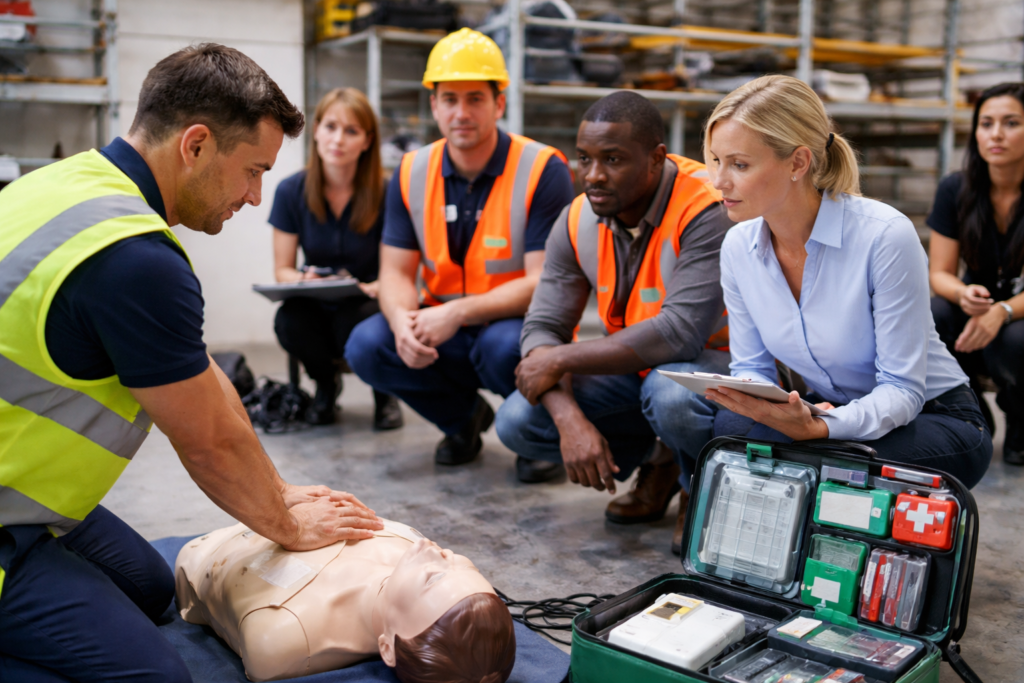
One of the most critical WHS obligations for NSW employers is ensuring effective first aid arrangements. This includes having:
Appropriately stocked first aid kits
Trained first aiders
Clear emergency procedures
The type of first aid training required in NSW depends on workplace risk levels, staff numbers, and industry type.
Commonly required courses include:
Therefore, maintaining up-to-date first aid certification is a practical and legally sound way to meet NSW workplace safety requirements.
In addition to general obligations, many industries face additional WHS compliance requirements.
Childcare services must meet WHS standards as well as regulatory requirements set by ACECQA.
Recommended training includes:
As a result, childcare providers ensure both WHS compliance and alignment with National Quality Standards.
Electrical workers and contractors must maintain Low Voltage Rescue (LVR) and CPR competency.
Relevant training options include:
Accordingly, this training helps employers meet both WHS obligations and industry licensing expectations
Another key part of WHS obligations for NSW employers is ensuring workers receive:
Proper inductions
Ongoing safety training
Adequate supervision
Training must be:
Relevant to workplace hazards
Current and refreshed regularly
Documented and verifiable
For this reason, employers should rely on nationally recognised courses listed on training.gov.au.
Safe systems of work support compliance and reduce incidents. These include:
Risk assessments
Safe Work Method Statements (SWMS)
Emergency response plans
Incident reporting systems
Importantly, first aid and CPR training directly support these systems by ensuring workers can respond effectively when incidents occur.
Although policies and paperwork are important, practical training is what protects people in real emergencies. First aid training:
Improves emergency response times
Reduces injury severity
Minimises downtime and compensation claims
Strengthens compliance during inspections
Training NSW delivers nationally recognised courses in partnership with ABC First Aid, ensuring employers meet WHS obligations with confidence.
When assessing compliance, regulators typically check:
Evidence of current first aid training
Valid HLTAID certificates
Risk-based training decisions
Emergency preparedness procedures
Therefore, maintaining up-to-date workplace safety and first aid training in NSW significantly reduces compliance risk.
Ultimately, meeting WHS obligations for NSW employers is about protecting people, reducing risk, and running a responsible business. With the right first aid and safety training in place, compliance becomes straightforward and manageable.
Training NSW delivers compliant training across Sydney and NSW, including CPR, First Aid, Childcare First Aid, and high-risk industry courses.
NSW employers must provide a safe workplace, manage risks, offer appropriate training, and ensure access to first aid.
Yes. Employers must ensure adequate first aid arrangements, which usually includes trained first aiders.
CPR (HLTAID009) should be refreshed every 12 months to remain compliant.
Yes. Childcare workers must complete HLTAID012 Childcare First Aid, aligned with ACECQA requirements.
All nationally recognised training can be verified on training.gov.au.