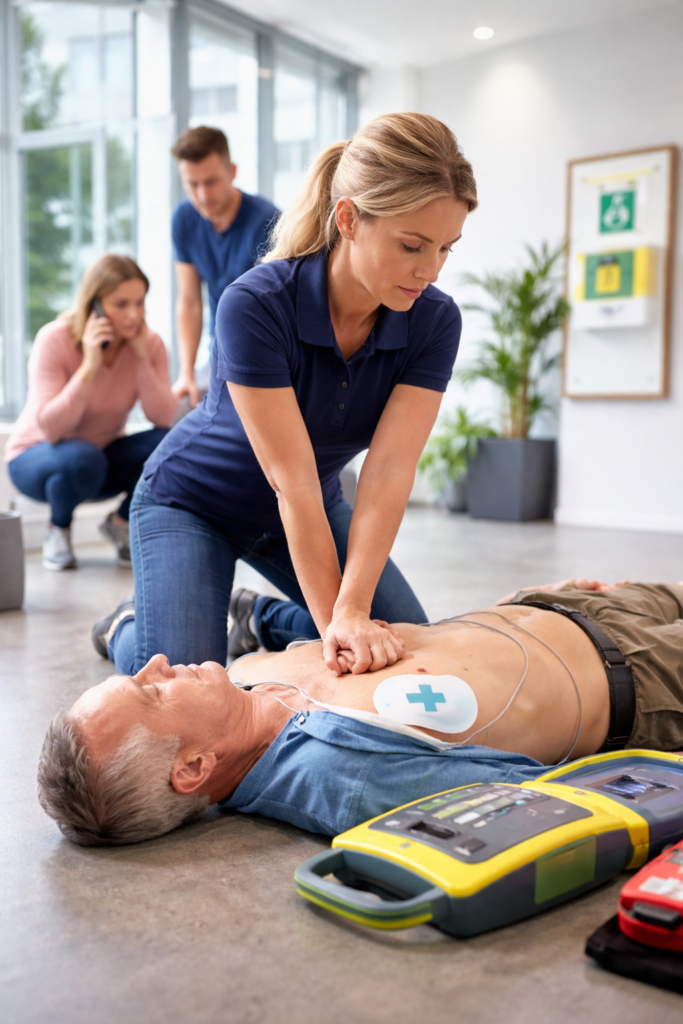
When sudden cardiac arrest happens, every second matters. In busy cities like Sydney and across New South Wales, early action can mean the difference between life and death. Fortunately, learning the basic steps for using an AED in an emergency is far simpler than most people think.
This Sydney-focused CPR and AED guide explains, step by step, how to use an AED quickly, safely, and confidently, even if you have never touched one before. Most importantly, it reflects the same practical approach taught in Training NSW’s nationally recognised CPR and First Aid courses.
An AED (Automated External Defibrillator) is a portable device designed to treat sudden cardiac arrest. It works by analysing the heart rhythm and, if required, delivering a controlled electric shock to restore a normal heartbeat.
Importantly, AEDs are:
Designed for public use
Guided by clear voice prompts
Safe for adults and children
Commonly found across Sydney and NSW
As a result, AEDs are now standard in workplaces, childcare centres, gyms, schools, shopping centres, and transport hubs.
First, check if the person is responsive by gently shaking them and calling out loudly.
If they are unresponsive and not breathing normally:
Call 000 immediately
Ask someone nearby to bring an AED
If you are alone, place your phone on speaker so emergency services can guide you while you act.
As soon as the AED arrives:
Open the lid or press the power button
The device will start giving voice instructions
At this point, you do not need to guess what to do. Simply listen and follow the prompts.
Next:
Expose the person’s chest
Remove or cut away clothing if necessary
Peel off the AED pads
Place:
One pad on the upper right chest
One pad on the lower left side of the chest
Thankfully, diagrams on the pads clearly show correct placement.
Once pads are attached:
Loudly say “Stand clear”
Ensure no one is touching the person
The AED will automatically analyse the heart rhythm.
If the AED instructs you to shock:
Press the shock button when prompted
Immediately after:
Resume CPR as directed by the AED
If no shock is advised, continue CPR straight away.
This entire AED process takes less than 60 seconds, yet it can save a life.
Across Australia, survival rates from out-of-hospital cardiac arrest remain low. However, studies consistently show that early CPR combined with rapid AED use can double or even triple survival rates.
Therefore, AED access and CPR training are strongly recommended for:
Workplaces and WHS officers
Childcare and education services
Construction and high-risk industries
Sports clubs and fitness centres
Parents, carers, and the wider community
While AEDs are easy to use, confidence comes from practice. At Training NSW, we focus on hands-on, real-world CPR and AED training so you feel prepared to act without hesitation.
Our most popular Sydney and NSW courses include:
All training is delivered in partnership with ABC First Aid (RTO 3399) and aligned with Australian Resuscitation Council (ARC) guidelines.
In particular, AED training is critical for educators and carers. Cardiac emergencies can occur at any age, which is why Childcare First Aid (HLTAID012) includes AED use for infants and children.
Similarly, workplaces across Sydney are increasingly expected to:
Install AEDs
Train staff in CPR and AED use
Maintain emergency response readiness
As a result, many employers now choose First Aid or Advanced First Aid training for compliance and safety.
Yes. AEDs are legally designed for public use. You do not need medical or first aid qualifications to operate one.
No. An AED will only deliver a shock if it detects a shockable heart rhythm. It is extremely safe.
Yes. Many AEDs include child pads or a child mode. The device will guide you through the process.
That’s okay. The AED provides clear voice instructions from start to finish.
Absolutely. CPR and AED use work together. CPR should resume immediately after the AED analysis or shock.
Training NSW delivers CPR and First Aid courses across Sydney and NSW.
👉 Book your course at https://trainingnsw.org
Knowing the correct steps to use an AED in an emergency is a critical life skill, especially in high-traffic environments across Sydney and NSW. However, while this guide provides a clear overview, it should always be supported by nationally recognised training and guidance from official Australian authorities.
For further trusted information and regulatory guidance, we recommend the following resources:
ABC First Aid (RTO 3399) – Nationally recognised First Aid and CPR training partner
Australian Skills Quality Authority (ASQA) – Australia’s national regulator for VET and RTOs
training.gov.au – Official register for nationally recognised training and accredited courses
ACECQA (Australian Children’s Education & Care Quality Authority) – Childcare and education compliance requirements
Australian Resuscitation Council (ARC) – National CPR and resuscitation guidelines
Together, these organisations set the standards that underpin CPR, AED use, First Aid, and childcare safety training across Australia.
Ultimately, reading about AED use is an excellent first step. However, hands-on CPR and AED training ensures you can act confidently and correctly when it truly matters. If you live or work in Sydney or NSW, Training NSW provides practical, nationally recognised courses to help you gain the skills, certification, and confidence to save a life.
Posted on Google
 Đăng Khôi Nguyễn
Trustindex verifies that the original source of the review is Google.
All goodPosted on Google Brenda De FilippisWe completed group training on-site and had an excellent experience from start to finish. Muhammad was professional, accommodating, and made the entire process feel effortless. Communication was strong and prompt throughout. I would not hesitate to recommend their services to anyone.Posted on Google
 Renee KimaniThe lessons were really educative. Mohammad Sadiqui was really helpful through the training. Loved it.Posted on Google
 Mariam AMohamad siddique is a great instructor. I always do my first aid and CPR herePosted on Google
 Jacob JidaMohammad siddiqua was very understandable and caring, he spoke to us one by one and loved working with us and giving his knowledge of experience, would highly recommend coming and doing your cpr and first aid course herebPosted on Google
 Naomi GituatiMy experience was amazing and educatingPosted on Google
 Ryan KipchumbaFantastic educational and very supportivePosted on Google
 Massey ShiraziNSW TRAINING trainer was one of the most energetic and positive person in CPR trainingLoad more